
© Dr Anurag S. Agarwal Eye Clinic. Privacy Policy
Powered by PRAZONE Web Solutions
As a team of experienced ophthalmologists led by Dr. Anurag Agarwal, practicing in Mumbai for over 25 years, we frequently diagnose patients with nuclear sclerosis, one of the most common age-related eye conditions. Many patients are confused when they hear this term and worry about their vision. In this comprehensive guide, we will explain what nuclear sclerosis is, how it develops, its symptoms, and available treatment options. Our goal is to help you understand this condition in simple language and make informed decisions about your eye health.
Nuclear sclerosis is a natural aging process that occurs in the lens of the eye. The word “nuclear” refers to the nucleus or central part of the lens, while “sclerosis” means hardening. As we age, the centre of the eye’s lens gradually becomes harder and denser, causing it to turn yellow or brown. This is a normal part of aging, similar to how hair turns grey or skin develops wrinkles.
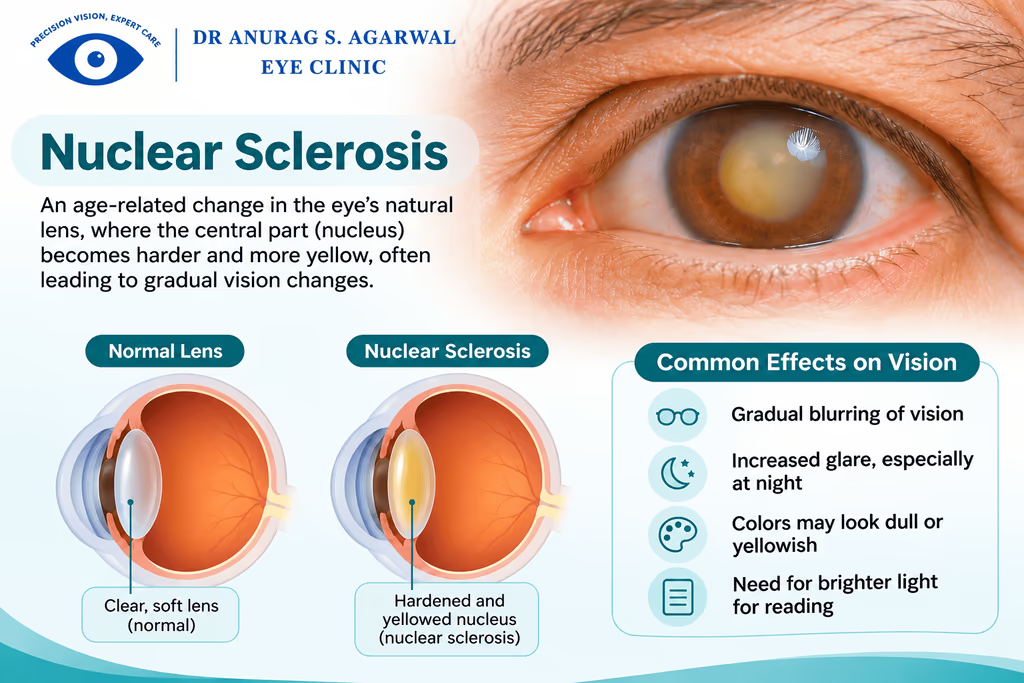
The lens is a clear, flexible structure inside the eye located behind the coloured iris and pupil. Its primary job is to focus light onto the retina at the back of the eye, allowing us to see clearly at different distances. In younger people, the lens is soft, clear, and flexible, easily changing shape to focus on objects both near and far.
As we age, several changes occur in the lens:
Continuous Growth: Unlike most body parts that stop growing after maturity, the lens continues growing throughout life. New lens fibres are constantly added to the outer layers, pushing older fibers toward the center. These compressed central fibers become the nucleus.
Compaction of Lens Fibers: As more fibers accumulate over decades, the central nucleus becomes increasingly compressed and dense. This compaction is the "sclerosis" or hardening process.
Protein Changes: The proteins in the lens nucleus undergo chemical changes with age. These proteins, called crystallins, begin to clump together and change structure, causing the lens to become less transparent and more coloured.
Loss of Water Content: The aging lens gradually loses water, contributing to increased density and hardness in the nuclear region.
Yellowing and Browning: Chemical modifications to lens proteins cause them to absorb light differently, resulting in yellow or brown discoloration of the nucleus. This color change affects how we perceive colours.
Nuclear sclerosis progresses through several stages:
In the early stage, the lens nucleus shows slight yellowing or increased density visible during eye examination. Most people experience no symptoms or only minimal changes in vision. This stage may be detected during routine eye examinations before patients notice any problems.
The nucleus becomes more yellow or brown, and the lens becomes noticeably denser. Patients may begin experiencing symptoms like difficulty with night vision, glare from lights, or slight blurring. Colour perception may start changing, with blues appearing faded.
When nuclear sclerosis progresses to significantly affect vision, it becomes a nuclear cataract. The nucleus turns dark brown or amber, vision becomes noticeably impaired, and daily activities become difficult. At this stage, the condition transitions from a normal aging change to a true cataract requiring treatment.
In the beginning stages, many people notice:
As nuclear sclerosis advances, symptoms become more pronounced:
Interestingly, some people with early nuclear sclerosis experience temporary improvement in near vision. This happens because the hardening lens changes the eye's focusing power, temporarily reducing the need for reading glasses. However, this "second sight" is short-lived, and vision eventually deteriorates as the condition progresses.
Nuclear sclerosis is primarily an age-related condition. It typically begins after age 40 and progresses gradually. By age 60, most people show some degree of nuclear sclerosis, and by age 80, nearly everyone has significant lens changes.
Family history plays a role. If your parents developed cataracts early, you may be more likely to experience nuclear sclerosis at a younger age.
Prolonged exposure to ultraviolet light from the sun accelerates lens aging and nuclear sclerosis development. In Mumbai's sunny climate, UV exposure is particularly relevant.
Tobacco use significantly increases the risk and speeds up progression of nuclear sclerosis. Smokers develop lens changes earlier and more severely than non-smokers.
High blood sugar levels accelerate lens aging processes, causing earlier and faster nuclear sclerosis development in diabetic patients.
Long-term use of certain medications, particularly corticosteroids, can accelerate lens changes and nuclear sclerosis.
Previous eye injuries may contribute to earlier or more rapid nuclear sclerosis development.
Poor diet, lack of antioxidants, and chronic inflammation contribute to lens aging and nuclear sclerosis progression.
Exposure to ionizing radiation, including from medical treatments, can accelerate lens changes.
Many patients ask about the difference between nuclear sclerosis and cataracts:
To diagnose and evaluate nuclear sclerosis, we perform comprehensive examinations:
We measure how clearly you can see at various distances using eye charts. This establishes baseline vision and tracks changes over time.
This specialized microscope allows us to examine the lens in detail, assessing the degree of nuclear sclerosis, colour changes, and density. We can grade the severity and monitor progression.
Special drops widen your pupils, enabling thorough examination of the lens, retina, and other internal eye structures. This comprehensive view helps us detect early nuclear sclerosis and rule out other conditions.
This test measures your ability to distinguish objects from their background, which nuclear sclerosis often affects before standard visual acuity declines.
We assess how bright lights affect your vision, important for evaluating nuclear sclerosis impact on night driving and daily activities.
Since nuclear sclerosis affects colour perception, we may test your ability to distinguish colours, particularly in the blue spectrum.
This advanced imaging provides detailed cross-sectional views of eye structures, helping us evaluate lens density and rule out other retinal conditions.
Treatment depends on the stage of nuclear sclerosis and how much it affects your vision. Early changes may be managed with simple adjustments, while advanced cataracts may require surgical treatment.
For early to moderate nuclear sclerosis that does not significantly affect daily life.
Regular prescription updates can compensate for gradual vision changes. Many patients manage well with new glasses for several years.
Increasing light intensity for reading and detailed tasks helps compensate for reduced light transmission through the yellowing lens. Use brighter bulbs and position lights appropriately.
Special lens coatings on eyeglasses reduce glare from headlights and bright lights, improving comfort and vision quality.
For reading and detailed work, magnifying glasses or electronic magnifiers help when vision becomes challenging.
Simple adjustments can make everyday activities more comfortable.
Scheduled eye examinations track progression and help determine when intervention becomes necessary. Annual examinations may be recommended for stable nuclear sclerosis, depending on your ophthalmologist's advice.
When nuclear sclerosis progresses to nuclear cataract and significantly impairs vision or quality of life, surgery may be recommended.
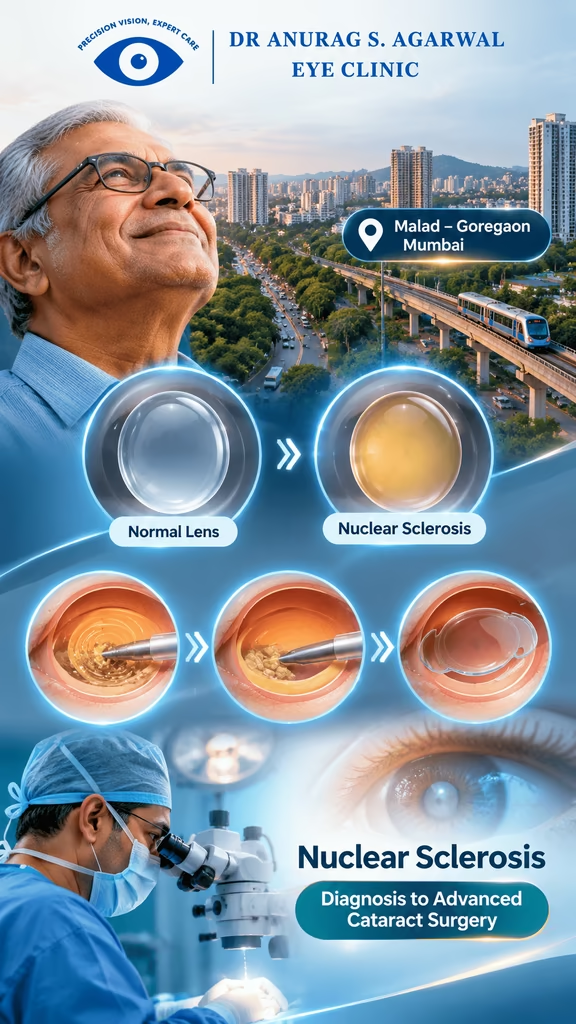
This modern technique uses ultrasound energy to break up and remove the hardened lens nucleus. A small incision (2–3 mm) allows removal of the cloudy lens.
For very dense, hard nuclear cataracts, SICS may be preferable. This manual technique removes the hardened nucleus through a slightly larger incision (6–7 mm) and may be useful for selected brunescent cataracts.
After removing the cloudy lens, an artificial lens is implanted to restore focusing power. Options include standard monofocal, multifocal and toric lenses, depending on suitability.
Advanced laser technology can be used to perform certain surgical steps with precision, although traditional techniques also achieve excellent results.
Cataract surgery is one of the most commonly performed and well-established procedures. Many patients experience significant vision improvement. Individual outcomes depend on overall eye health and other existing eye conditions.
Your ophthalmologist may recommend considering surgery when:
Nuclear sclerosis is a natural ageing process. Although it cannot always be prevented, certain healthy habits may support long-term eye health.
Wear sunglasses with 100% UV protection whenever outdoors. In Mumbai's sunny climate, this is particularly important year-round.
If you smoke, quitting can help reduce your risk of cataract development and support long-term eye health.
Consume foods rich in antioxidants, including:
Control diabetes, hypertension and other health conditions through regular medical care.
Excessive alcohol intake may contribute to faster cataract development. Avoid excessive consumption as part of a healthy lifestyle.
Annual comprehensive eye examinations can help detect nuclear sclerosis early and monitor its progression.
Vitamins C and E, lutein and zeaxanthin have been studied for eye health. However, supplements have not been proven to prevent or reverse nuclear sclerosis. A balanced diet is generally preferred.
Many people live comfortably with mild to moderate nuclear sclerosis for years by making simple adaptations.
Nuclear sclerosis does not always require immediate surgery. Early assessment, regular monitoring and timely treatment can help you maintain good vision and independence. If you notice increasing blurriness, difficulty seeing at night or worsening glare, consult an ophthalmologist for a comprehensive eye examination.
With over 25 years of experience in Mumbai, Dr. Anurag Agarwal has diagnosed and treated thousands of patients with nuclear sclerosis and nuclear cataracts. His comprehensive approach focuses on accurate diagnosis, clear communication and appropriate treatment at every stage.
Find answers to common questions about nuclear sclerosis, its progression, treatment and cataract surgery.
Nuclear sclerosis refers to the hardening and yellowing of the central part of the eye's natural lens, commonly associated with ageing. When these changes become significant enough to affect vision, they are considered a nuclear cataract. Not every case of early nuclear sclerosis requires treatment.
Nuclear sclerosis usually begins after the age of 40, although noticeable symptoms may develop much later. The degree of lens changes varies from person to person.
No. Nuclear sclerosis cannot be reversed through medications, eye drops or lifestyle changes. When it progresses to a cataract that affects vision, cataract surgery can remove the cloudy lens and replace it with an artificial intraocular lens.
Progression varies greatly among individuals. Some people experience slow changes over many years, while others may develop more noticeable changes sooner. Regular eye examinations help monitor your condition.
Not necessarily. Many people live comfortably with mild to moderate nuclear sclerosis without surgery. Cataract surgery is generally considered when vision impairment begins affecting daily activities, independence or quality of life.
No. Nuclear sclerosis itself is not painful. It usually causes gradual vision changes without discomfort. Eye pain may indicate another eye condition and should be evaluated promptly.
Yes. Nuclear sclerosis commonly affects both eyes, although the degree and speed of progression may differ between the two eyes.
No. Wearing glasses does not prevent nuclear sclerosis because it is primarily an age-related change in the natural lens. However, suitable eyeglasses can correct refractive changes, and UV-protective sunglasses help protect the eyes from ultraviolet exposure.
Many patients notice vision improvement within a few days. Healing and visual stabilisation can take several weeks, often around 4–6 weeks. Recovery time varies depending on the surgical technique and individual eye health. Follow your surgeon's post-operative instructions.
Nuclear sclerosis itself does not usually cause complete blindness. However, if it progresses to an advanced nuclear cataract and remains untreated, it can cause severe vision impairment. Cataract surgery can often restore useful vision, depending on the health of the rest of the eye.
If you are experiencing vision changes, difficulty distinguishing colours or problems with glare, do not delay seeking professional evaluation. Dr. Anurag Agarwal and his experienced team in Mumbai specialise in diagnosing and managing nuclear sclerosis at different stages.
Whether you need regular monitoring, non-surgical management or cataract surgery, the treatment approach is based on your individual eye condition and visual requirements.
Schedule a comprehensive eye examination to understand the condition of your natural lens and discuss suitable treatment options. With over 25 years of experience in Mumbai, Dr. Anurag Agarwal focuses on timely diagnosis and appropriate care to help patients maintain their vision and quality of life.
Whether you need reassurance about early lens changes, guidance on managing nuclear sclerosis or expert treatment for advanced cataracts, Dr. Anurag Agarwal and his team are here to help. Contact our Mumbai clinic to arrange your eye examination.
Nuclear sclerosis is a natural part of ageing, but poor vision does not have to be accepted as inevitable. With appropriate monitoring and treatment when needed, many people can maintain good functional vision. Take the first step by arranging a comprehensive eye examination.
With over 25 years of experience performing eye surgeries in Mumbai, Dr. Anurag Agarwal has mastered various techniques. Dr. Agarwal’s commitment to providing accessible eye care has made him a trusted name among patients seeking quality eye treatment at affordable costs.
Dr. Anurag Agarwal, a top eye surgeon in Mumbai, choosing the right cataract lens is an important decision that can significantly impact your quality of life. Our team of experienced ophthalmologists in Mumbai is here to guide you through the selection process and help you achieve the best possible vision outcome. Schedule a comprehensive consultation with us today to discuss your cataract surgery options and receive personalized recommendations based on your unique needs and goals. Contact us now to take the first step towards clearer, more vibrant vision